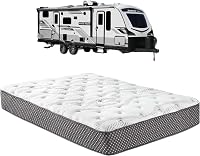
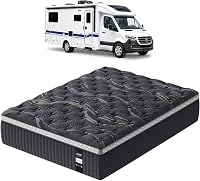
What Size Is a Camper Mattress?
A camper mattress usually is not a standard home size. Common camper beds run 30 x 75 inch bunks, 60 x 74 or 60 x 80 inch queens and 72 x 80 inch kings, and a camper mattress often reads an inch or two narrower or shorter than the same-named house mattress.
On this page (10 sections)
- What size is a camper mattress in common RV layouts?
- How do camper mattress sizes compare with home sizes?
- How do you measure a camper bed before buying?
- Which mattress fits each camper bed size?
- Are camper mattresses standard sizes across brands?
- How thick should a camper mattress be?
- Does mattress type change the size you need?
- What if your camper bed is an unusual size?
- How do you confirm the size before you order?
- What size is a camper mattress? The bottom line
A camper mattress usually is not a standard home size. Common camper beds run 30 x 75 inch bunks, 60 x 74 or 60 x 80 inch queens and 72 x 80 inch kings, and a camper mattress often reads an inch or two narrower or shorter than the same-named house mattress.
So the honest answer to what size is a camper mattress is another question: which bed does your camper actually have?
The name on the floor plan won't settle it. Two campers from different makers can both call a bed a queen and sit 2 or more inches apart.
Measure the frame first, then buy.
What size is a camper mattress in common RV layouts?
Camper mattress sizes fall into a handful of families, but the inches vary by layout and maker. Treat the names as a starting point and the measured frame as the deciding number.
| Common name | Typical size (W x L) | Usual location |
|---|---|---|
| Bunk / twin | 28 x 75 or 30 x 75 | Kids' bunks, bunkhouse models |
| Full | 53 x 75 | Small trailers and some motorhomes |
| Short queen | 60 x 74 or 60 x 75 | Travel trailers and fifth wheels |
| RV queen | 60 x 80 | Larger motorhomes |
| RV king | 72 x 80 | Big fifth wheels and toy haulers |
The short queen is the workhorse. It saves 5 to 6 inches of length against a home queen, which matters when the bed sits across the trailer's width or up against a slide.
A bunk runs narrower than a home twin, often 30 inches wide, leaving room for the ladder or the storage beside it.
None of these are guaranteed. A 28 inch bunk in one camper is a 30 inch bunk in the next.
Always check your own frame.
Our guide to RV queen mattress size goes deeper on the 60 x 74 against 60 x 80 split. If your bed folds up into a wall, the RV Murphy bed mattress guide covers what works on that hinge.
Why camper beds don't match home sizes
A camper is built around its walls, tanks, plumbing and slide-outs before anyone thinks about the bedroom. The bed gets whatever rectangle is left.
A "queen" in a trailer is shorthand for "the big bed in the back," not a promise of 60 x 80 inches.
Weight matters too. Every pound of mattress is a pound the trailer carries, so makers keep beds short and thin.
A 10 inch hybrid is a real upgrade over the 4 to 5 inch pad many campers ship with.
Measure your frame and ignore the name. That's the only rule that holds across brands.
How do camper mattress sizes compare with home sizes?
Almost every camper size is shorter, narrower or both compared with the home size it borrows its name from, with the RV queen the exception. The gaps are small enough to tempt you into buying the home version and large enough that it won't fit.
| Camper size | Camper inches | Closest home size | Home inches |
|---|---|---|---|
| Bunk | 30 x 75 | Twin | 38 x 75 |
| Full | 53 x 75 | Full | 54 x 75 |
| Short queen | 60 x 74 or 60 x 75 | Queen | 60 x 80 |
| RV queen | 60 x 80 | Queen | 60 x 80 |
| RV king | 72 x 80 | King | 76 x 80 |
The short queen loses 5 to 6 inches of length. In a trailer that can be the difference between walking past the foot of the bed and climbing over it.
The bunk loses 8 inches of width against a home twin. The RV king loses 4 inches of width against a home king, so bedding bought for a home king will hang loose.
The full size is the closest match, usually within an inch of a home full. It's the one size where a standard mattress can sometimes drop in without drama.
Some campers also carry a "king" that's really 72 x 74, short in both directions. The floor plan and the tape measure beat any chart.
Buy for the frame you have, not the bed you wish you had. A too-long mattress will foul a slide or a door before you even sleep on it.
How do you measure a camper bed before buying?
Measure the frame's clear inside width and length, not the old mattress. A worn mattress bulges and sags, so its numbers can be 1 to 2 inches off in either direction.
Do it in this order:
- Pull the old mattress out and clear the platform.
- Measure the clear width between the bed rails, to the nearest half inch.
- Measure the clear length from the head wall to the foot wall or rail.
- Measure the height from the platform to the top of the bed rail.
- Measure the clearance from the platform to the ceiling or overhead cabinet.
- Check the door width and the turn into the bedroom if the mattress arrives rolled or boxed.
Those last two decide more purchases than people expect. A 12 inch hybrid in a bunk with a low overhead cabinet leaves no room to sit up.
A mattress that can't make the corner into the bedroom never gets used, no matter how comfortable it is.
Write the three core numbers down: width, length and available thickness. Carry them in your phone when you shop.
For a full replacement plan across every bed type, our RV mattress replacement guide walks through the options by layout.
Check the slide-out and door swing
A bed that sits under a slide-out only gets its full length when the slide is out. Measure with the slide retracted too, because that's how you'll travel.
If the foot of the bed blocks a bathroom door when the slide is in, a longer mattress makes that worse.
Memory foam can often be trimmed with a long knife to fit. A pocketed coil mattress does not cut cleanly.
Measure once with the slide in and once with it out. Buy for the smaller of the two unless the mattress stays put while you travel.
Which mattress fits each camper bed size?
Match the mattress type to the bed, not the other way around. A bunk wants thin foam, a short queen wants a hybrid with real support, and a Murphy bed wants something that folds or stays flat.
Best for short queen main bedrooms: Grbsy 12-Inch Zoned Hybrid RV Short Queen
The Grbsy short queen measures 60 x 75 inches and runs medium firm. It stacks a breathable Euro-top, gel memory foam and more than 1,000 pocket springs in three zone types.
Graphene-infused fabric in the cover and copper ions in the foam target heat and odors, which matter in a small camper where air doesn't move much.
The reinforced edges use edge-responsive coils and extra edge foam. In a tight bedroom you'll sit on the edge to pull on shoes, so a firm perimeter helps.
Grbsy offers a 365-night trial and a 10-year warranty, and the mattress ships rolled in a box that fits through an RV door.
Pick it if your frame measures 60 x 75 and you want a thick, supportive bed for the main sleeping space. The 12 inch height needs clearance above it, so check your overhead cabinets first.
Best for short queen on a budget: WanderRest Cool Hybrid 10-Inch Short Queen
The WanderRest measures 60 x 74 inches, an inch shorter than the Grbsy. Check your frame length carefully if your bed sits tight against a wall or a slide.
It combines gel-infused memory foam, high-density comfort foam and pocketed coils in a medium feel that suits a wide range of sleepers. The gel foam responds to body temperature and pulls warmth away, and the HD edge system adds perimeter stability so the sides don't collapse when you sit.
RV Mattress Solutions builds it in the USA and backs it with a 10-year warranty. At 10 inches it's easier to fit under a low cabinet than the 12 inch Grbsy.
Pick it if your frame is 60 x 74 and you want cooling foam without the extra height. Pick the Grbsy if your frame runs 60 x 75 and you'd rather have the deeper build.
Best for tight camper bunks: hoggisleep 6-Inch Aquasoft Bunk 30x75
The hoggisleep bunk mattress pairs 2 inches of AquaSoft memory foam over a 4 inch high-density base. That's a real step up from the thin pad many campers ship with, without eating the headroom a bunk can't spare.
At 28 lb it's light enough to lift when you need to get at the storage under the bunk. hoggisleep builds it in Verona, Mississippi and backs it with a 10-year limited warranty. The cover is a breathable diamond soft fabric with a non-slip bottom and a red pull loop. hoggisleep uses CertiPUR-US certified foams and says the mattress meets motor vehicle flammability requirements, which matters in a camper.
Pick it if your bunk measures 30 x 75 and you want a thin, cool-feeling upgrade. A 6 inch mattress won't suit a main bedroom where you want a deep hybrid feel.
Are camper mattresses standard sizes across brands?
No. Camper mattress sizes vary by maker, model year and even the same model's trim level.
The names are shared, the inches are not.
If you order a "short queen" without measuring, you might get 60 x 74 when your frame is 60 x 75. That inch can stop a mattress from sitting flat or leave a gap at the foot.
Our guide to whether camper mattresses are standard size digs into the brand-by-brand differences. Read it before you order anything online.
The safe routine is the same every time: measure width, length and available thickness from your own frame, then match a mattress to those numbers, not to the name on the floor plan. Some makers publish a size chart by model year.
Use it as a cross-check, but don't skip the tape measure.
Trust the tape, not the name. A mattress that's 1 inch long will rock or overhang, and neither feels good after a week on the road.
How thick should a camper mattress be?
Camper mattresses usually run 6 to 10 inches thick, and bunks do best at the thin end. The right number depends on how much headroom your bed has, not on what feels plushest in a showroom.
Thickness changes how high you sit, how much you can store under the bed and how easy the mattress is to lift or fold.
A 6 inch foam mattress like the hoggisleep keeps a bunk usable. Kids and adults can sit up without hitting the cabinet above.
It also weighs 28 lb, so you can lift it to reach storage. A 10 inch hybrid like the WanderRest suits a main bedroom where the ceiling is higher.
A 12 inch hybrid like the Grbsy feels closest to a home mattress, but needs the most clearance above the bed rail.
Measure from the platform to the top of the bed rail, then add the mattress thickness. Compare that total with the space to the overhead cabinet.
Leave at least a few inches for your knees and feet when you sit on the edge.
Pick the thinnest mattress that still supports you. In a camper, headroom is the limit, and a mattress that's too thick turns a usable bed into a cramped one.
Does mattress type change the size you need?
Mattress type changes how the size fits, not just the inches. Foam bends and compresses, while a hybrid with coils holds its shape and resists folding.
Foam mattresses ship rolled and compressed in a box, which makes them far easier to get through a camper door and around a corner into a tight bedroom.
The Grbsy and the WanderRest also arrive compressed in a box that fits an RV doorway. Once expanded, the coil core holds the full thickness and doesn't squish down like all-foam.
For a Murphy bed that folds into a wall, a thick mattress can stop the bed from closing flat or strain the hinge. The RV Murphy bed mattress guide covers which types work on that mechanism.
For a bunk, an all-foam mattress bends to fit a curved or odd-shaped platform. A coil mattress won't follow a curve, so it needs a flat, rectangular base.
Choose foam for awkward shapes and folding beds, and a hybrid for a flat main bed. The size still has to match your frame either way.
What if your camper bed is an unusual size?
Odd camper beds are common, and the fix is usually foam you can trim or a custom cut. A 74 inch short queen, a 28 inch bunk or a corner bed with a clipped corner all exist.
If your frame measures close to a standard camper size, buy that size and accept a small gap or slight overhang.
A 1 inch gap at the foot is easy to live with. A mattress that's 2 inches long will bunch against the wall and wear out fast.
If your bed is far off any standard size, look for an all-foam mattress you can cut. A long knife and a straight edge will trim foam cleanly.
Cut from the foot end and keep the cover intact as much as you can. Don't cut a pocketed coil mattress.
The coil unit won't trim evenly and you'll end up with a lumpy edge.
Measure twice and cut once. It's much easier to take an inch off than to add one back.
When the size is odd, foam is your friend. Cut to fit rather than forcing a standard size into a space it wasn't built for.
How do you confirm the size before you order?
Confirm the size against your measured frame and the mattress's listed dimensions, not the name on the product. A short queen can be 60 x 74 or 60 x 75, so check the exact inches.
Do this before you click buy:
- Recheck your width and length against the mattress dimensions in inches.
- Confirm the thickness clears your overhead cabinet and bed rail.
- Check the shipping box size against your camper door and hallway turns.
- Note the mattress's weight if you need to lift it for storage.
- Check the return window and trial terms in case the fit is wrong.
Check the exact inches on the product page before you order, since the same name can hide a 1 inch difference. That's the one place a quick look at the page saves a return.
The WanderRest at 60 x 74 and the Grbsy at 60 x 75 are a good example. Both are "short queen," but an inch apart.
Measure your frame to the half inch and pick the closer match.
If your camper's bed is longer than 75 inches or narrower than 28, no standard camper mattress will fit cleanly. Look at custom foam or a topper cut to size instead.
Measure, match the inches, then order. The name on the box is a label, not a guarantee.
What size is a camper mattress? The bottom line
A camper mattress usually isn't a standard home size. It's whatever rectangle your camper's walls, tanks and slide-outs left for the bedroom, and that's often a 30 x 75 bunk, a 60 x 74 or 60 x 75 short queen or a 72 x 80 king.
The name borrows from home furniture, but the inches don't always follow.
Measure your frame's clear width and length to the half inch, plus the headroom above the bed. Then match a mattress to those numbers.
For a short queen main bedroom, the 12 inch Grbsy at 60 x 75 gives the most support, and the 10 inch WanderRest at 60 x 74 is the easier fit under a low cabinet. For a tight bunk, the 6 inch hoggisleep 30x75 keeps the headroom you need.
Whatever you choose, the tape measure decides. Check the exact inches on the product page, compare them with your own numbers and buy the closest match.
That's how you get a camper mattress that actually fits.
Frequently asked questions
Is a camper mattress the same as a home mattress size?
No. Camper beds often share a name with home sizes but not the exact inches, so a short queen measures 60 x 74 or 60 x 75 while a standard home queen is 60 x 80.
Measure your bed frame before ordering, because the same name can hide a shorter or narrower fit.
What is the most common camper mattress size?
The short queen is the most common size in travel trailers and fifth wheels, usually 60 x 74 or 60 x 75 inches. Bunks are the second most common, typically 30 x 75 or 28 x 75, and many motorhomes mix a short queen in the main bedroom with bunks for guests.
Can I put a standard home mattress in a camper?
Sometimes, but it rarely fits well. A standard 60 x 80 queen is 5 to 6 inches longer than a short queen, and that extra length can block a slide, a door or the space you need to walk around the bed.
Thickness and flex matter too, so check the frame and headroom first.
Do camper mattress sizes differ by brand?
Yes. Two campers from different makers can both call a bed a queen and measure 2 or more inches apart.
Even within one brand, the same model year can change the bed size.
The only safe number is the one you measure from your own frame, not the name on the floor plan.
How do I measure a camper bed for a new mattress?
Measure the frame's clear inside width and length to the nearest half inch, not the old mattress, which can bulge or sag. Also measure the height from the platform to the top of the bed rail and the clearance above it.
Write those three numbers down and match a mattress to them.
What thickness works best in a camper?
Most camper beds work with a 6 to 10 inch mattress, though bunk beds usually do better with a thinner 6 inch model. Measure the height from the platform to the top of the bed rail, then allow room to sit up and swing your legs out without hitting the cabinets.