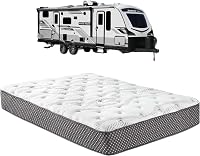
RV Mattress Size 66 x 80: Fit and Options
An RV mattress 66 x 80 inches is a custom-width king used in some fifth wheels and larger motorhomes. Measure your platform before ordering, because 72 x 80 and 60 x 75 are far more common sizes and a 66-inch width leaves only 6 inches of side gap in a 72-inch opening.
On this page (9 sections)
- Is 66 x 80 a standard RV mattress size?
- How do you measure a 66 x 80 RV bed correctly?
- What fits in a 66 x 80 RV space?
- Which products work in a 66 x 80 space?
- Is a custom 66 x 80 mattress worth ordering?
- How do you handle the 6-inch gap?
- What about sheets and protectors for this size?
- How does a 66 x 80 bed fit into an RV layout?
- Which size should you pick for your rig?
An RV mattress 66 x 80 is a custom-width king that shows up in some fifth wheels and larger motorhomes. Measure your platform first, because this size sits between a 60-inch RV queen and a 72-inch RV king, and neither of those swaps in cleanly.
If your bed measures 66 inches across and 80 inches long, you're not stuck. A few makers cut to order, and there are practical ways to fit a more common mattress without losing the whole platform.
The sections below walk through fit, options and the products we'd start with.
Is 66 x 80 a standard RV mattress size?
No, 66 x 80 is not a standard size. It's a builder-specific or custom width, and that matters because standard sizes are the ones you can replace quickly.
The common RV mattress sizes are RV short queen at 60 x 75, RV queen at 60 x 80 and RV king at 72 x 80. A 66-inch mattress sits 6 inches wider than a short queen and 6 inches narrower than an RV king.
That in-between width usually comes from a slide-out frame or a platform built around a specific cabinet run.
Why some RVs use 66 inches
A 66-inch width often appears where a full 72-inch king would block a slide or crowd a wardrobe. Builders shave inches to keep the walkway usable.
The result is a bed that sleeps two comfortably but doesn't match any mass-market size.
That's the catch: when the original mattress wears out, the owner can't grab a standard replacement off a shelf. Custom width means custom order, longer lead times and less choice in cover and foam type.
It also means accessories like protectors and sheets are harder to find in the exact size.
Measure your platform before you buy anything, even if the old mattress label says 66 x 80. RV frames flex, and the opening at the head end can differ from the foot end by an inch or more.
How do you measure a 66 x 80 RV bed correctly?
Measure the smallest width and depth of the platform, not the mattress. A mattress that's squeezed into an opening will buckle, and one that's too loose will slide when you brake.
- Run a tape across the platform at both ends and in the middle, then use the smallest width.
- Measure depth from the wall or headboard edge to the foot of the platform.
- Check the corner radius if your bed sits in a slide-out with rounded corners.
- Measure the doorway width and any hallway turns between the door and the bed.
- Check overhead clearance for a mattress in a box before it expands.
A mattress in a box ships compressed and rolls through most RV doors, which helps when the boxed size is smaller than the finished mattress. An 80-inch mattress still needs an 80-inch platform, though, so don't stretch the length to make it fit.
Check the opening, not the old label
The label on the old mattress can be wrong, especially after a previous owner swapped it. Trust the tape.
If the platform measures 64 inches at one end and 67 at the other, order to the smaller number or plan for a filler piece.
Write your numbers down before you shop. Every size decision later in this guide depends on that width and depth, so keep them in your phone when you compare options.
What fits in a 66 x 80 RV space?
A 60-inch mattress fits with a 6-inch gap on one side, and a 72-inch mattress won't fit at all. That leaves a few realistic paths, and each one has a trade-off.
The simplest is to buy a standard size narrower than the opening and fill the gap. The most faithful is a custom cut to 66 x 80.
The middle route is a standard width that's close enough to work with a small filler.
Option 1: A 60 x 80 RV queen with a filler
An RV queen mattress at 60 x 80 is 6 inches narrower than your opening. It's the easiest standard size to find and the easiest to replace later.
A 6-inch strip of firm foam or a custom filler board takes up the gap so the mattress doesn't shift.
The downside is the lost width. Two adults lose 6 inches of shoulder room compared with the original bed.
If your platform is against a wall on one side, the gap matters less, because the filler can sit against the wall where nobody sleeps.
Our guide to RV queen mattress size covers the difference between 60 x 80 and 60 x 75, which matters if your depth is closer to 75 inches.
Option 2: A 72 x 80 RV king, trimmed to fit
An RV king at 72 x 80 is 6 inches too wide, so it won't drop in as-is. Some owners trim the foam edge to fit, but that only works on all-foam models.
A hybrid with coils has a steel edge that can't be cut without ruining the mattress.
If your opening has room to overhang on one side, an RV king can work with a support platform under the overhang. That's a custom build, not a simple swap.
See our RV mattress 70 x 80 guide for the size just below a full RV king.
Option 3: A custom-cut mattress at 66 x 80
A custom order is the only way to get the exact width. Makers who cut to order build the mattress to your numbers, so there's no gap and no trimming.
Lead times are longer and the price tier is usually mid-range to premium, since each one is made for you.
This route makes sense if the bed is a fixed platform you'll keep for years and the 6 inches of width genuinely matter. For a weekend camper or a bed you might replace in a couple of seasons, a standard size with a filler is the cheaper, easier call.
Option 4: Two smaller mattresses side by side
Two 33-inch foam pieces or two narrow bunks pushed together can build a 66-inch bed. It's a popular DIY route, but the seam in the middle is a real problem for couples.
A mattress connector or a thick topper helps hide the gap.
Which products work in a 66 x 80 space?
The products we'd pick for a 66 x 80 platform are short queen mattresses plus a filler, because exact 66 x 80 options are limited. These three are the closest fit for most owners.
The Grbsy is our top pick for this size because it packs the most support features into a short queen. It's 12 inches thick with a Euro top, gel memory foam and 1,000 pocketed coils, and the medium firm feel suits side, back and combination sleepers.
A 60 x 75 footprint leaves a 6-inch width gap and a 5-inch length gap on your 66 x 80 platform, so plan a filler strip and a foot board.
The zoned pocket springs help isolate movement when two people sleep close together, which matters more on a narrower bed. The graphene-infused cover and cooling gel foam aim at the heat that builds in a closed-up RV.
The Celestial Sleep is the pick when you want a lower profile. At 10 inches it sits 2 inches lower than the Grbsy, which helps if your platform is high or your cabinets hang low over the bed.
It's gel bead infused memory foam in three layers, medium firmness, and it ships rolled for easy setup.
The all-foam build is also the easier one to trim if you decide to cut a custom width, since there's no coil edge to ruin. That makes it a practical base for a DIY 66-inch fit.
The Kingnex protector is the small add-on that protects whichever mattress you choose. It's a fitted sheet style with a stretch skirt that reaches up to 14 inches deep, so it covers both the 10-inch and 12-inch options above.
The TPU backing blocks spills and moisture, which matters in an RV where humidity and condensation build up.
It's machine washable and has a smooth, quiet surface, so it doesn't change the feel of the mattress. For a 66-inch platform with a 60-inch mattress, the stretch skirt also helps hold the mattress against the filler strip.
Is a custom 66 x 80 mattress worth ordering?
A custom order is worth it when the bed is a long-term keeper and the extra 6 inches of width matters every night. Otherwise, a standard short queen with a filler costs less and is far easier to replace on the road.
Think about how often you'll replace it. A custom mattress can take weeks to arrive and can't be swapped at a store in the next town.
A standard size can be bought almost anywhere if the foam fails mid-trip.
When custom makes sense
Choose custom if the platform is fixed, the bed is your main sleep surface, and you plan to keep the RV for several seasons. It's also the better route if the opening has a rounded corner or a tapered end that a standard mattress can't fill.
Custom also helps if you have a specific comfort need. A maker who cuts to order can usually adjust foam firmness within limits.
A standard mattress gives you whatever feel that model ships with.
When standard makes more sense
Stay standard if the bed is a guest surface, a weekend camper, or a rig you might sell in a year or two. A 60 x 80 RV queen with a filler is the lowest-risk choice, and the mattress is easy to move to your next RV if the size matches.
Decide by how long you'll keep the rig, not by how much you dislike the gap. The gap is fixable with foam; a custom order that misses by an inch is not.
How do you handle the 6-inch gap?
Fill the gap with a firm foam strip or a fitted board so the mattress stays put. A loose mattress on a wide platform slides when you brake and sags at the edge over time.
The cleanest fix is a strip of high-density foam cut to 6 inches wide and 80 inches long, pushed against the wall side. A mattress connector or a long wedge pillow on top hides the seam.
If the gap sits at the foot end instead, a board or a foam block works the same way.
Gaps at the wall and at the foot
A gap against the wall is the easier one to manage. Foam filler sits there and nobody sleeps on it.
A gap at the foot is more awkward, because feet can slip into it. A firm foam wedge or a padded foot board fills that space and keeps the sheets tight.
Measure the actual gap after the mattress expands. A mattress in a box grows for a few hours, so the finished width can differ slightly from the box label.
Fit the filler after that.
When a topper helps
A thick topper can bridge a small gap and soften the transition. It won't fix a 6-inch gap on its own, though.
Use the filler first, then add a topper if the mattress feels too firm or you want to smooth the edge.
What about sheets and protectors for this size?
Standard RV short queen sheets fit a 60-inch mattress, not a 66-inch one, so plan your bedding around the mattress you buy. Custom width needs custom bedding or stretchy sheets.
If you keep the 66 x 80 platform with a 60 x 80 mattress, use RV queen sheets and tuck the extra width under the filler side. If you go custom, order sheets in the custom size or use deep-pocket sheets with a stretch skirt.
Protectors sized to the mattress
A protector needs to match the mattress, not the platform. The Kingnex protector above fits a 60 x 75 short queen, so it's the right cover for the two short queen picks.
For a custom 66 x 80 mattress, order a protector in the same custom size.
Waterproof protection matters more in an RV than in a house. Condensation, spills and humidity all work on foam, and a wet mattress in a closed camper can grow odor.
A fitted protector is the cheap insurance.
How does a 66 x 80 bed fit into an RV layout?
A 66-inch mattress is usually a slide-out or a fixed island bed, and the layout decides whether you can widen or narrow it. Check what the bed sits against before you change the size.
An island bed has walkway on both sides and needs the full width. A bed against one wall can lose 6 inches without anyone noticing, because the gap falls on the wall side.
A slide-out bed has to clear the slide walls when it moves.
Slide-outs and clearance
Measure the clearance between the mattress and the slide frame. A thicker mattress, like the 12-inch Grbsy, sits higher and can catch the frame or the overhead cabinet when the slide comes in.
Check the finished height before you commit.
The 10-inch Celestial Sleep gives you 2 more inches of clearance than the 12-inch option. On a tight slide, that difference can decide whether the bed closes without rubbing.
Doorways and delivery
A mattress in a box is the easiest to get inside. Both mattresses above ship compressed and roll through a standard RV door.
A custom mattress often arrives flat, so confirm the doorway width and the turn into the bedroom before ordering.
Our guide to RV sofa bed mattress dimensions covers the other places in an RV where odd sizes show up.
Which size should you pick for your rig?
Pick a 66 x 80 custom mattress if you keep the RV long term and sleep on the bed every night. Pick a 60 x 80 or 60 x 75 short queen with a filler if you want easy replacement and a lower cost.
Here's the short version:
- Long-term full-timer with a fixed platform: custom 66 x 80, or trim a 10-inch all-foam mattress to fit.
- Weekend camper: 60 x 75 short queen plus a 6-inch foam filler, the cheapest and easiest swap.
- Tight slide-out: a 10-inch mattress for clearance, not a 12-inch one.
- Two adults sleeping close: a hybrid with pocket coils to limit motion transfer.
Before you order anything, measure the platform, the doorway and the slide clearance. Then choose the mattress that matches those numbers, not the size on the old label.
For the next size up the ladder, see our guide to RV mattress 70 x 80. If your bed folds away, our RV mattress for murphy bed guide covers the hinge and thickness rules that matter more than width.
The 66 x 80 RV mattress size is uncommon, but it isn't a dead end. Measure twice, choose a standard size with a filler or a custom cut, and protect the foam once it's in place.
That's the whole decision.
Frequently asked questions
Can I put a 60 x 80 RV queen on a 66 x 80 platform?
Yes, but you'll lose 6 inches of width and the foam will likely shift into the gap unless you block it. A 6-inch filler strip or a custom-cut piece of foam is the usual fix.
Measure the platform depth as well, since an 80-inch mattress needs an 80-inch base.
How do I measure for a 66 x 80 RV mattress?
Measure the widest point of the platform at both ends and in the middle, then measure the depth from the wall or headboard to the foot edge. Use the smallest width and depth you find.
Check doorway widths and any slide-out clearance before ordering, because an 80-inch mattress won't fit through a narrow RV door in its box.
Will a standard king mattress fit in a 66 x 80 RV space?
No. A standard king is 76 x 80 inches, so it's 10 inches wider than a 66 x 80 space and won't fit between most RV side walls.
An RV king at 72 x 80 is still 6 inches wider.
Check your opening before buying anything called a king.