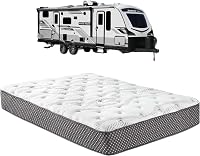
RV Mattress vs Regular Mattress: Key Differences
An RV mattress is cut to camper dimensions, so it's usually shorter and sometimes narrower than the same-named home size. A regular mattress rarely fits an RV platform without overhang or wasted space, so the main difference is size first and build second.
On this page (8 sections)
- What is the main difference between RV mattress and regular mattress sizes?
- How much smaller is an RV king than a regular king?
- What other sizes change between a camper and a home?
- How does the build of an RV mattress differ from a home mattress?
- Which mattress fits an RV short queen platform?
- Can a regular mattress work in an RV instead?
- How do you measure and choose the right mattress?
- The bottom line on RV mattress vs regular mattress
An RV mattress is cut to camper dimensions, so it's usually shorter and sometimes narrower than the same-named home size. A regular mattress rarely fits an RV platform without overhang or wasted space, so the difference between RV mattress and regular mattress comes down to size first and build second.
If you've measured your platform and the gap is real, the choice is clear: buy the RV cut. A regular mattress only makes sense when your platform is a true home size and the doorway lets it in.
What is the main difference between RV mattress and regular mattress sizes?
The main difference is length and width. A home queen is 60 x 80 inches, while an RV short queen is 60 x 75 inches, so you lose 5 inches of length.
An RV king is narrower than a home king too.
Those few inches matter in a camper. A mattress that's 5 inches too long pushes against a wall or blocks a cabinet door.
One that's too wide leaves no walkway.
RV beds also come in cuts that don't exist at home, like the short queen and the RV king. Our guide to RV queen mattress size covers the 60x80 versus 60x75 split in detail.
Measure your platform's length, width and the clear height above it. Write those numbers down before you shop.
How much smaller is an RV king than a regular king?
An RV king is narrower than a home king. A standard king is 76 x 80 inches, and the common RV king runs closer to 72 x 80 inches.
You give up width, not length.
Some RV kings are shorter as well, so the exact cut depends on the camper. Two coaches from different makers can carry different "king" platforms.
The lost width changes how two people sleep. A 72-inch-wide bed is still generous, but it's closer to a queen in shoulder room.
Our RV king vs regular king comparison shows the full difference in inches. Measure the platform itself, since the label on the bed can be loose.
What other sizes change between a camper and a home?
Queens, kings and fulls all get cut down in campers, and bunks use their own sizes. A home full is 54 x 75 inches, and camper fulls vary too.
Twin bunks are often shorter or narrower than a home twin.
Our what is a queen RV mattress page explains how the queen label gets applied to more than one camper size. A "queen" in one coach can be a short queen in another.
Murphy beds are their own case. A folding platform needs a mattress that bends or a foam model that tolerates the fold.
Our guide to the RV mattress for murphy bed covers that fit.
Write down the size from your platform, not from the old mattress label. Labels fade and coaches get sold with the wrong bedding.
How does the build of an RV mattress differ from a home mattress?
RV mattresses are often thinner and lighter, and many are foam. A 12-inch hybrid like the Grbsy is thick for a camper, while many RV models sit at 8 to 10 inches to clear cabinets and bunks.
Weight matters for two reasons. You may need to lift the mattress to reach storage underneath, and every pound counts against your payload.
Campers also hold moisture. Foam models that resist mildew and odors are easier to live with in a small, closed space.
Hybrids with coils add airflow but weigh more.
Home mattresses are built for a house: thicker, heavier and often with a long warranty. An RV mattress trades some of that for a cut that fits and a weight you can manage.
Which mattress fits an RV short queen platform?
A short queen mattress cut to 60 x 75 inches fits, and nothing else does without overhang. All three picks below are short queens built for camper platforms.
Our score weighs specs and features against what a camper sleeper needs. It isn't a test result.
Which short queen suits most campers?
The Grbsy 12-Inch Zoned Hybrid is the strongest all-round pick for a short queen platform. Its 12-inch build adds thickness over the thin 8-inch camper mattresses many coaches ship with.
Grbsy uses 1,000 pocket coils in a 7-zone layout, plus cooling gel memory foam and a graphene-infused cover. The copper and charcoal in the foam are there to absorb odors and moisture in a closed camper.
Motion isolation is the practical win for couples in a narrow bed. Reinforced edges help too, since you'll be sitting on the edge to dress in tight quarters.
It ships compressed in a box that fits through an RV door. Grbsy backs it with a 365-night trial and a 10-year warranty.
Check the exact height of your platform and cabinet gap before ordering.
Which short queen is best for a tight budget?
The Celestial Sleep 10-Inch is the simpler, lighter short queen. At 10 inches thick and 57 pounds, it fits under lower cabinets and is easier to lift than the hybrid.
Celestial Sleep uses cooling gel bead memory foam in three layers with a quilted cover. The foam conforms to your body and keeps the mattress flexible for odd camper access.
It's made in the USA and carries CertiPUR-US and OEKO-TEX certifications. That matters in a small space where foam odors linger.
Foam without coils means less airflow, so pair it with a breathable protector in humid climates. It suits one sleeper or a couple who wants a light, low-profile bed.
Which short queen is best for hot sleepers?
The EGOHOME 10-Inch Gel Memory Foam brings green tea gel and a bubble-hole foam structure for airflow. It's the pick if your camper gets stuffy at night.
The foam is medium firm and pressure-relieving, and EGOHOME says the material holds its firmness across temperature changes. It's 10 inches thick and weighs 42 pounds, the lightest of the three.
The open-cell structure is meant to move air and heat. That's useful in a camper with one small window and no real cross-breeze.
It's a foam mattress, so expect less edge support than the hybrid. Sit toward the middle when you can, and give it time to expand after unboxing.
Can a regular mattress work in an RV instead?
Sometimes, but only when the platform is a true home size and the doorway lets it in. A regular mattress is usually heavier and less moisture-resistant, so it's rarely the better camper choice.
Check three things before you try. First, does the platform measure a home size, like 60 x 80?
Second, will the mattress clear cabinets, walls and the door swing? Third, can you lift it to reach storage?
If the platform really is home-sized, a regular mattress can work. For most campers, the RV cut is the right buy.
How do you measure and choose the right mattress?
Measure the platform, not the old mattress. Run a tape along the longest and widest points of the bed base.
Then measure the clear height from the platform to the nearest cabinet or bunk rail.
Check the doorway and hallway too. A compressed mattress in a box is easier to get inside than a full-size one, which is why most RV mattresses ship rolled.
Match the mattress thickness to the clearance. A 12-inch model like the Grbsy needs more headroom than a 10-inch one.
In a bunk, thin wins.
Weigh the mattress against your lifting needs and payload. If you lift the bed to reach storage daily, the 42-pound EGOHOME is easier than the 66-pound hybrid.
Then pick by comfort: hybrid for support and edges, foam for light weight and a low profile. If you're still unsure between the labels, the RV queen mattress size page settles the 60x80 versus 60x75 question.
If back pain keeps you awake on the road, talk to a doctor before you assume a mattress will fix it. For the folding platform case, the RV mattress for murphy bed guide covers what to buy.
The bottom line on RV mattress vs regular mattress
The difference between an RV mattress and a regular mattress is mostly the cut. Buy the RV size your platform measures and the difference disappears.
Force a home mattress into a camper bed and you'll fight overhang, lost walkway or a blocked cabinet for as long as you own it.
For a short queen, pick the Grbsy 12-Inch hybrid if you want support, edges and a thick build. Pick the Celestial Sleep 10-Inch for a lighter, simpler foam bed.
Pick the EGOHOME 10-Inch if heat is your main problem.
Then check the size once more. Measure the platform and the gap above it before you order, because the fit is the whole reason RV mattresses exist.
Frequently asked questions
Can I cut a regular mattress down to fit an RV?
No. Cutting foam or coils opens the fire barrier and voids the warranty, and the cover won't reseal cleanly.
Buy a mattress already cut to your platform size instead.
Is an RV mattress shorter in height as well as length?
Sometimes. RV mattresses are often thinner than home models so they clear overhead cabinets and bunk rails.
Measure the gap above the platform before you buy anything thick.
Do RV mattresses use the same sheets as home beds?
Not always. A short queen needs short queen sheets, while an RV king needs narrower sheets than a home king.
Check the exact dimensions before buying bedding.
Why do RV mattresses cost more than home mattresses of the same size?
Smaller production runs and less competition push prices up. You're paying for a cut that fits a specific platform, not for better materials.
Can I put a regular mattress in an RV if it fits?
Yes, if it clears the walls, cabinets and doorway. A regular mattress is often heavier and less moisture-resistant, though, so check the weight and ventilation first.